How water, sanitation are aiding education in Kab
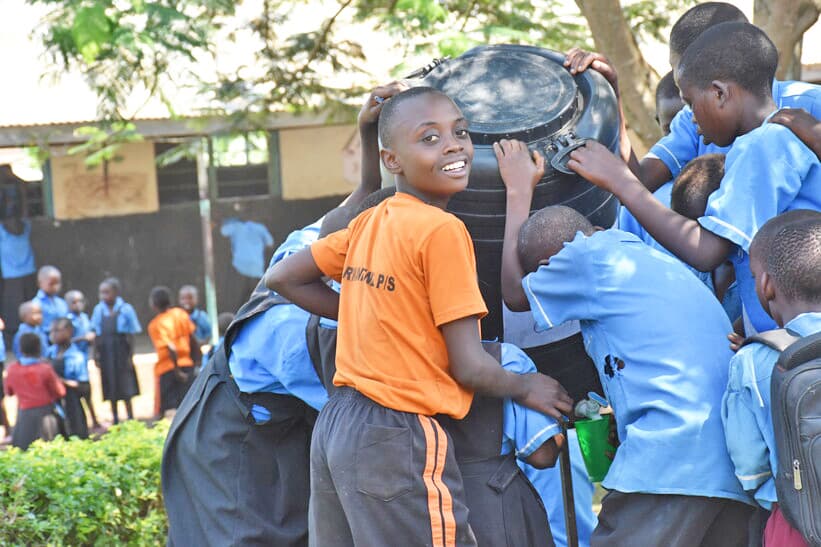
Rwankenzi Primary School in Kabarole, Uganda, has seen significant improvements in academic performance and student health. These gains are attributed to new water and sanitation infrastructure provided by the IRC WASH program.
_________________ The targets may be distinct, but interventions towards the Sustainable Development Goal 6 (SDG) on water and sanitation are benefiting education, health and gender equality, among others. Gerald Tenywa and Naomi Kabarungi reveal how Kabarole is doing it. For the first time in its history, Rwankenzi Primary School in Kasenda sub-county, Kabarole district, is outperforming the neighbouring private schools. Janerose Kiiza, who is the headmistress of the school, says that they used to get less than five first grades, meaning that performance has improved by more than four times. The school has increased its enrolment, and girls dropping out has become a thing of the past. Above all, complaints about diarrheal diseases have declined. "We had 600 pupils in 2021, but now the numbers have increased to 721. Parents used to take the best pupils away to what used to be better schools for P6 and P7, but now they keep children in our school because they are getting good value for their money," says Kiiza. This has come to Rwankenzi because of a clean learning environment, thanks to the piped water extension and safe toilets, and the attitude that the school has recently acquired. The disease burden, which was previously high, has been checked ever since Rwankenzi got hooked to the local piped water network. "We used to have up to 15 children falling sick in a day. But of late, we can take a week without anyone falling sick. This has reduced absenteeism," she says. Behind the scenes, Rwankenzi has created change agents to influence what they want to see in the future. "We have a school management committee and an active health club to monitor and spread the gospel on water and sanitation," the head teacher says. "The committees in the school community encourage behavioural change." Rwankenzi is one of the schools in Kabarole benefiting from transformative model programmes for WASH (Water and Sanitation) in Schools by IRC WASH (International Water and Sanitation Centre). The school health club and management committee are trained to influence positive hygiene attitudes among peers and to advocate for improved budget for water and sanitation for the learners, respectively. The long-standing problem of menstrual hygiene management at Rwankenzi Primary School has come to an end. "Girls are no longer dropping out of school," Kiiza says, adding that they have prepared both the girls and the boys to ensure that menstruation does not disrupt the girls. "The boys and girls can make menstrual hygiene materials, says the head teacher. "We put in some money and buy materials for making pads, while the children use their acquired skills to hand-make the pads," says Kiiza. Such milestones are speaking for the interventions Kabarole and her partners are taking to bring water and sanitation to schools as well as the communities. Bringing water to people Kasenda sub-county, where Rwankenzi Primary School is located, is known for its many crater lakes that attract tourists from far and wide. Yet, the communities find it hard to access safe water. Originally, the national water supply utilities would not consider serving places such as Kasenda with piped water, preferring to focus on urban centres that offer better business. This is where the alternative Umbrella Authorities have come in to extend safe water supply to rural growth centres including Kasenda that were previously unserved. "Now we have piped water, but sometimes the flow is irregular," Kiiza says, adding that they were engaging the leadership of the Umbrella to ensure that they get a more consistent supply of water. "The school also harvests rainwater, which we can only use for the hygiene facilities but not for drinking, but even that is not available all the time." The children at Rwankenzi Primary School enjoy the innovative water-saving handwashing station known as the WASHALOT. "I get water to drink from the can when I want it, there is a new clean toilet with toilet paper, and we can all wash our hands on the WASHALOT before eating our lunch," says Joventa Ninsiima, a pupil in P6. Her schoolmate believes there is no better school in Kasenda than Rwankenzi. "I do not have any plans of leaving until I finish my studies," says Rita Nasasira, a pupil in P7 at Rwankenzi Primary School. The milestones at Rwankenzi Primary School stem from steps taken by the school and Kabarole district to put people at the centre of water and sanitation interventions. Kabarole has 61 schools, and Rwankenzi has provided a blueprint to replicate water and sanitation interventions in the other schools. How about the rest of the country! Think globally, act locally Six years ago, Kabarole became the first district in Uganda to draft a plan for safe water and sanitation: the Kabarole District WASH Master Plan 2018 - 2030. This is expected to bring home what is referred to as the 2030 sustainable development agenda or the Sustainable Development Goals (SDGs) with the renowned slogan: leaving no one behind. World leaders, including President Yoweri Museveni, agreed on 17 interconnected goals (SDGs) in 2015, ending in 2030. SDG6 is about water, sanitation and hygiene, which remains one of the biggest outstanding challenges in the developing world, including Uganda. The 2030-Kabarole district master plan helps to guide partners in the water and sanitation sector where and how to intervene as well as the resources - money, people and technology - to be deployed.
Get the full story
Sign up for Headlinne to unlock AI insights, political bias analysis, and your personalized news feed.
Create free accountAlready have an account? Sign in