Stores set fuel pellet purchase limits - producers say there's plenty to go around
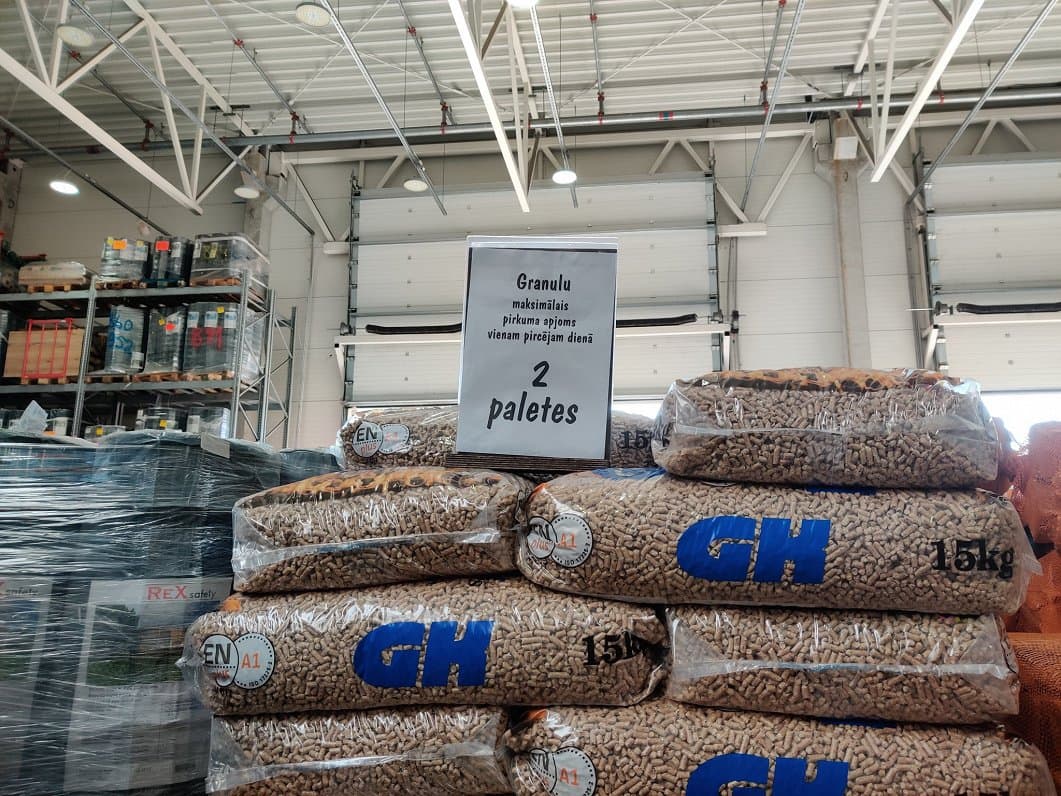
Latvian stores have implemented purchase limits on wood pellets due to a surge in consumer demand ahead of the winter season. Industry experts describe the situation as temporary 'hype' and expect the market to stabilize within a month.
Demand has grown rapidly, but the association representing the industry says the market is gradually starting to calm down and, most likely, the situation will stabilize within a month. Many houses and businesses in Latvia use dry wood pellets as their principal heating source during the long, cold winter. As the hype in the pellet market has begun, stores have set restrictions. In both "Depo" and "KSenukai" stores, one buyer can purchase a maximum of two pallets of pellets per day. The stores admit that the demand for pellets is still high but are reluctant to comment in detail. Didzis Palejs, chairman of the board of the Latvian Biomass Association "LATbio", says that this is temporary hype: "Quite simply, the reason for the hype is that people are preparing for the next season in good time. And what they need for the next winter, they try to buy in one or two months. The main problem is that demand is not spread out over the entire year, but they try to buy the entire year's volume in one or two months, and then tensions arise." It can be predicted that the market will gradually calm down. "I see that most people have already bought their pellets. There are few who haven't bought the pellets yet. Or people have already lined up at the manufacturer and are waiting for them to be delivered. This means that demand will likely start to slide down and the hype could end in a month and a half, when most people will have procured everything they need," Palejs says. Palejs explained how long the lines are now: "From a week to a month - it depends on where. But the feeling is like this, at least the day before yesterday morning I spoke with the producers - with those who are in the association - and there is a feeling that demand is already starting to go down." The head of the association explains that this summer is notable for the fact that a lot of goods are being purchased by Polish buyers, which affects prices. Currently, pellet prices have already exceeded 300 euros per tonne, compared to 220 euros per tonne a year ago. "The fact that Poles buy from us at prices higher than those sold by pellet producers on the local market is due to the fact that some Polish traders apparently hope that pellet [prices] will be higher in the season and are probably buying more expensively purely for speculative purposes, but it is difficult for me to comment, this is my personal opinion," says the head of the Latvian Biomass Association "LATbio". Palejs does not think that this hype is related to the recent cyberattack on "Latvijas Valsts meži" (Latvian State Forests), which affected processes and supplies: ""Latvijas Valsts meži" produces roundwood and the lowest quality roundwood, mostly in the form of firewood, is the raw material for industrial pellets, which is a different type of product... [Those used] by households or medium-sized boilers, such as in municipalities, are premium-class pellets, and their raw material is wood chips and shavings, and they come from sawmills. And if a sawmill has a shortage of sawlogs from "Latvijas Valsts meži" for a while, then there may be some downtime at the sawmills, but as far as I know, all sawmills keep sawlogs in stock for at least a month in advance. Therefore, even if there were delays in deliveries for these few weeks, it is unlikely that it will significantly affect the work of the sawmills by stopping the work of the sawmills. As far as I know, there are no such incidents." Currently, most of the production is exported, but the local market is a priority. "Our production is several times greater than local consumption. The total installed production capacity is close to two million tonnes. And the local market consumption, estimated after last year's cold winter, was around 350 thousand [tonnes]. "Once again, we have enough pellets. We will never have all the pellets bought here in Latvia... For all producers who are members of the association, the priority is the local market. They are slowing down export volumes and directing additional volumes to the local market to quell the current hype," Palejs explains. The head of the association adds that officials such as ministers should consider their public pronouncements carefully so that they do not contribute to unnecessary hype and create a market run. President Edgars Rinkēvičs spoke about proposals to stabilize the situation in the fuel market this week, during a meeting with Climate and Energy Minister Jānis Vitenbergs (National Alliance). Vitenbergs promised on the "Labrīt" program that there would be pellets: "We will do everything so that the situation that existed last season does not repeat itself. Because we are a couple of months ahead of the heating season and there are opportunities to organize the market in a way that takes care of people," he said.
Get the full story
Sign up for Headlinne to unlock AI insights, political bias analysis, and your personalized news feed.
Create free accountAlready have an account? Sign in