UST doctors perform advanced cardiac procedure
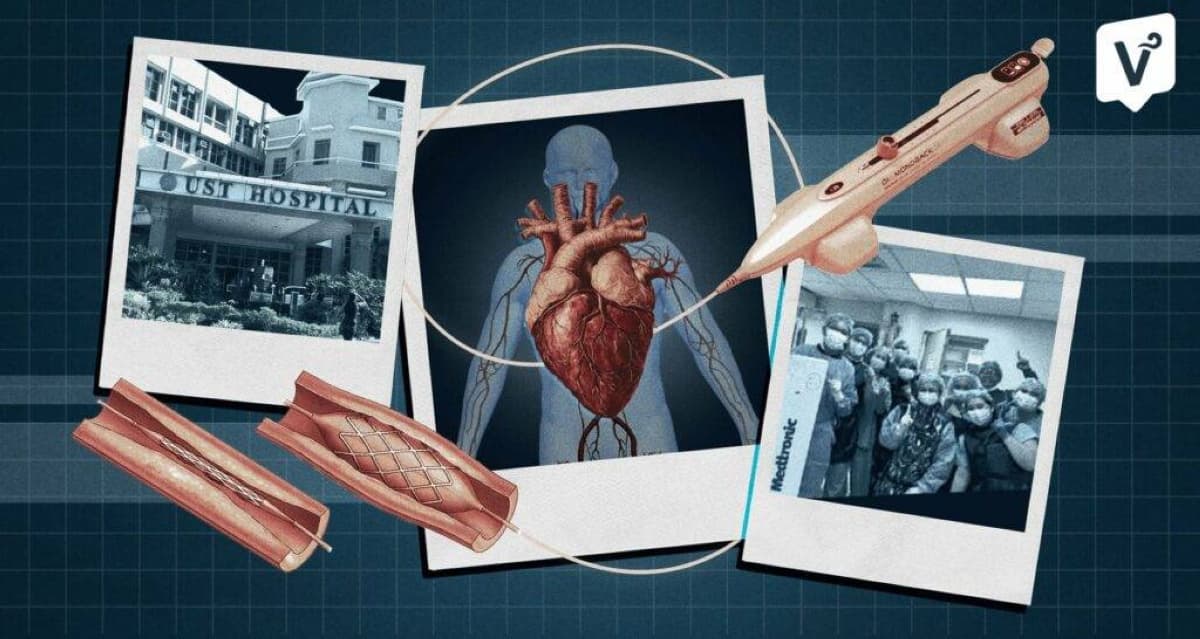
Doctors at the University of Santo Tomas Hospital have successfully performed an orbital atherectomy, a procedure using a diamond-tipped device to clear severely calcified heart arteries. This marks a significant advancement in cardiac care for patients who are not candidates for traditional bypass surgery.
THE Varsitarian on July 6 published a report about a diamond-tipped device that has "helped doctors at the University of Santo Tomas (UST) Hospital clear a severely hardened heart artery for the first time, expanding treatment options for patients whose blockages are too calcified for conventional angioplasty."Here's the rest of the report:The procedure, called orbital atherectomy, uses a rapidly rotating diamond-coated crown to sand down calcium deposits inside the artery before a stent is placed, allowing doctors to restore blood flow in cases where conventional balloon angioplasty may not be enough.Dr. Eric John Marayag, an interventional cardiologist at UST Hospital, said the procedure was the first orbital atherectomy case performed outside the Philippine Heart Center, where fewer than 10 similar cases had been done.Marayag led the two-hour procedure in May with senior interventional cardiologist Dr. Ronaldo Estacio, cardiovascular catheterization laboratory nurses, a cardiac anesthesiologist, and the company Abbott, which provided the Diamondback 360 orbital atherectomy system.The patient was an 80-year-old man with severe coronary artery disease and extensive arterial calcification. Marayag said the patient had vague chest pain and was later found to have a high calcium score in the heart, a sign of heavy calcium buildup in the coronary arteries."Ideally, this patient was for coronary artery bypass graft because he had a very calcified lesion, and there were a lot of blockages," Marayag told the Varsitarian. "But because of his age, he opted for a less invasive [option]." Coronary artery disease occurs when the blood vessels that supply the heart become narrowed or blocked by plaque. In some patients, these blockages harden because of calcium deposits, making them difficult to open with standard tools."In balloon angioplasty, we insert a balloon inside the artery and inflate the balloon in order to crush [the blockage]," Marayag said. "And since this is a balloon, sometimes when the blockages are very hard, especially when it's already calcified, the balloon is not enough." Orbital atherectomy begins with coronary angiography, an imaging test that allows doctors to see blockages in the heart's blood vessels. A catheter is inserted through an artery in the wrist or groin, followed by a wire and the atherectomy device."When you press the activation of the atherectomy device, the diamond will rotate at 80,000 to 125,000 rotations per minute," Marayag said. "During that rotation, it somehow modifies the calcium by sanding it." Once the calcium is sanded down and the artery becomes expandable, doctors insert a stent, a small mesh tube that keeps the artery open and helps restore blood flow.Marayag said modifying the calcium first was crucial because a stent could fail to expand in a heavily hardened artery, reducing blood flow and raising the risk of future blockage."The patient is at risk for future cardiac events if you are not able to open the stent during the procedure," he said.The patient remained awake but was mildly sedated during the procedure. The team monitored his blood pressure, heart rate, oxygen levels and overall stability throughout the intervention."More than the procedure itself and more than the outcome itself, patient safety is our highest priority throughout the intervention and any intervention for that matter," Marayag said.Marayag said the patient was discharged after two days of monitoring and was stable and asymptomatic after the procedure.Compared with open-heart bypass surgery, which may require seven to eight days of recovery, orbital atherectomy is minimally invasive and allows faster recovery. Marayag said patients may walk the day after the procedure but must continue medication, lifestyle changes and regular follow-up.UST Hospital's use of orbital atherectomy could help widen access to advanced cardiac procedures, especially for patients in Manila and those referred from the provinces."Usually, full ang schedule sa Heart Center," he said. "So at least this can be a pivot or a crossroad, and I'm glad that UST Hospital is the first outside [the] Heart Center to offer this," Marayag said.The cardiology section seeks to develop UST Hospital into a cardiovascular institute that will bring together cardiologists, cardiac surgeons, anesthesiologists, specialized nurses, and other health professionals involved in cardiovascular care, he said.The hospital also plans to submit the case as a research report and make complex cardiac procedures available to indigent patients under its clinical division."We want to expand and share this milestone with them as well," Marayag said. MARIGELA ISABEL R. CIRIO (Reprinted with permission from the Varsitarian adviser)
Get the full story
Sign up for Headlinne to unlock AI insights, political bias analysis, and your personalized news feed.
Create free accountAlready have an account? Sign in